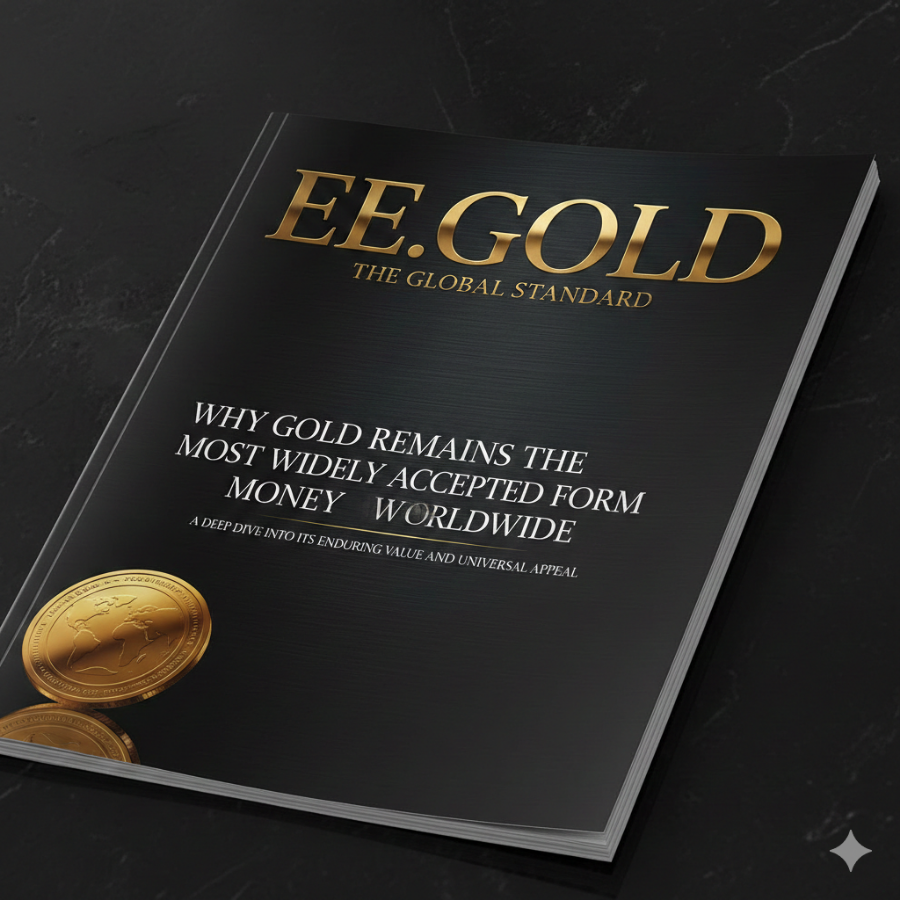
In an era dominated by fiat currencies and emerging digital alternatives like Bitcoin, gold continues to hold a unique position as the most enduring and universally recognized form of money. While no country today operates on a full gold standard, gold's intrinsic qualities, historical legacy, and ongoing role in global finance ensure its widespread acceptance as a reliable store of value and medium of exchange in times of crisis.
The Timeless Qualities That Make Gold Money
Gold has served as money for over 5,000 years, dating back to ancient civilizations in Lydia (modern-day Turkey) around 600 BCE, where the first gold coins were minted. Its selection as a monetary metal was no accident; gold possesses the essential characteristics of sound money:
- Scarcity: Unlike fiat currencies that can be printed at will, gold's supply grows slowly—historically at about 1-2% per year through mining. All gold ever mined would fit into a cube roughly 23 meters on each side.
- Durability and Indestructibility: Gold does not corrode, tarnish, or degrade over time, making it a permanent store of wealth.
- Divisibility and Fungibility: It can be divided into smaller units without losing value and is uniform— one ounce of pure gold is identical to another anywhere in the world.
- Portability and Universality: Gold is dense, valuable in small quantities, and recognized across cultures and borders without needing government backing.
- Intrinsic Value: Beyond monetary use, gold has industrial applications (e.g., electronics) and aesthetic appeal in jewelry.
These properties allowed gold to outcompete other commodities like silver, shells, or livestock as money. As explained through the periodic table analogy, most elements are impractical (gases, liquids, radioactive, or reactive), leaving gold as one of the few stable, rare, and malleable options.
In contrast, fiat money—government-issued currency not backed by a commodity—relies entirely on trust in authorities. While convenient for everyday transactions, fiat is vulnerable to inflation, devaluation, and political manipulation. Bitcoin, often called "digital gold," offers scarcity (capped at 21 million coins) and decentralization but suffers from extreme volatility and limited real-world acceptance.
Gold's Historical Dominance in Monetary Systems
Gold's role peaked during the classical gold standard era (1870s–1914), when major economies tied their currencies to fixed amounts of gold. This system facilitated stable international trade, low inflation, and economic growth. Exchange rates were fixed, and gold flows automatically balanced trade deficits.
The system evolved through the interwar period and Bretton Woods (1944–1971), where the U.S. dollar was convertible to gold at $35 per ounce, and other currencies pegged to the dollar. The U.S. abandoned convertibility in 1971 amid rising deficits, ushering in the modern fiat era.
Yet gold never vanished. In hyperinflation crises—like Venezuela in recent years—people revert to gold flakes or coins for transactions. Historically, commodities that retain value longest become money, and gold has proven unmatched in this regard.
Gold's Enduring Acceptance Today
As of late 2025, gold prices have surged past $4,000 per ounce, reflecting its renewed appeal. Central banks have been aggressive buyers: over 1,000 tonnes annually in recent years, with holdings now valued at around $4.5 trillion—surpassing euro reserves and rivaling U.S. Treasuries in some metrics. Emerging markets like China, India, Turkey, and Poland lead this trend, diversifying away from dollar-heavy reserves amid geopolitical tensions and de-dollarization efforts.
Surveys show 95% of central banks expect global gold reserves to rise further. Gold represents about 20% of all reserves worldwide, underscoring its role as a "shadow standard"—insurance against fiat instability.
In private markets, gold is universally accepted in bullion form for large transactions, jewelry trade, or as a hedge. During crises, it functions as money where fiat fails: accepted borderlessly, without counterparty risk.
While not legal tender in most countries (except U.S.-minted coins in some U.S. states or nominally elsewhere), gold's acceptance stems from trust in its inherent value, not legal mandate. No fiat currency matches this global, apolitical recognition.
Why Gold Outshines Alternatives
Fiat offers flexibility for governments but has led to persistent inflation and debt crises since 1971. Bitcoin provides scarcity and portability but lacks gold's stability and millennia-proven track record—its price swings make it speculative rather than reliable money.
Gold bridges the gap: scarce like Bitcoin, tangible and stable like historical money, and universally trusted. In a world of uncertainty—rising debt, geopolitical risks, and currency debasement—gold remains the ultimate safe haven.
As central banks hoard record amounts and investors flock to it amid 2025's volatility, gold reaffirms its status. It may not circulate in daily pockets, but as the most widely accepted form of true money, its shine endures.
NOTE
This Content is the copyrighted content of EE.GOLD. All rights are reserved. You are welcome to share or use our content only by including direct links to our website. Any other form of reproduction, distribution, or use without proper attribution is strictly prohibited.
This Content is intended solely for educational purposes. The information provided does not constitute financial or investment advice.
Please note that Digital Storage Receipt, Secure Storage Solutions, and Physical Gold Sales are the only services offered by EE.GOLD.
We strictly adhere to government regulations and are firmly against all illegal financial or investment activities globally.
For further inquiries, feel free to contact us through our official channels.








.png)